What Crew Members Say About Fugro-Equator
IMO: 9627411
Research Vessel, Bahamas
Photos
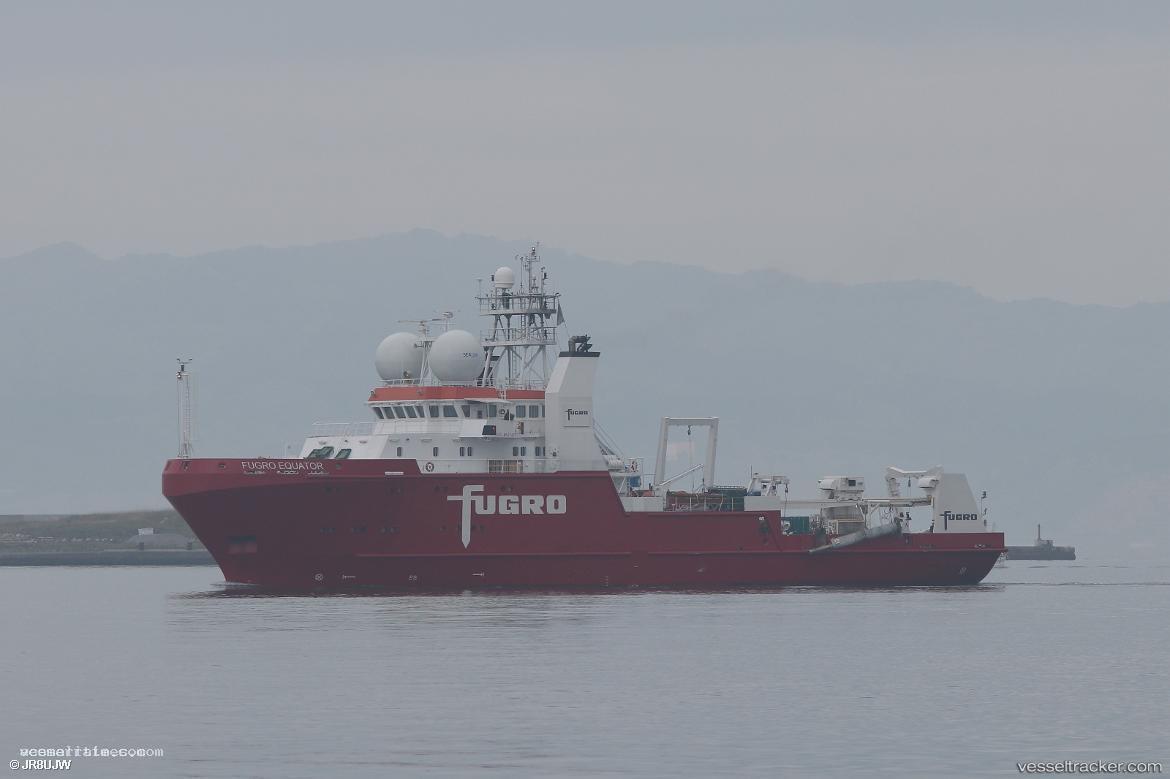
Vessel Details
MMSI
311065700
Callsign
C6ZT5
Width
14.0 m
Length
65.0 m
Reviews (1)
Daniel
2024-03-08
Position: Second Engineer
Advantages:
Looking for information about this vessel. Any thoughts on this ship? Would sail again?
Disadvantages:
No personal experience yet, just gathering info.
Latest News (3)
Discovery of 'Montevideo Maru' Wreck Marks Significant Maritime Milestone
After nearly five years of meticulous planning, the crew aboard the 'Fugro Equator' has made a groundbreaking discovery: the wreck of the 'Montevideo Maru', a notorious site of one of the worst maritime disasters ever recorded. In an effort bolstered by collaboration with the Silentworld Foundation and the Rabaul and Montevideo Maru Society, and with the valued support of Australia’s Department of Defence, Fugro leveraged their exceptional hydrographic and oceanographic capabilities to locate the sunken Japanese transport ship at an astonishing depth of over 4,000 meters off the Philippine coast. On July 1, 1942, the 'Montevideo Maru' was tragically sunk by the American submarine USS 'Sturgeon' while it was transporting approximately 1,060 prisoners of war and civilians, with the submarine's crew unaware of the lives aboard. Most of the men had been taken prisoner by Japanese forces in Rabaul, Papua New Guinea, prior to the sinking; among them were 850 Australian soldiers and 129 Australian civilians, making this catastrophe the worst maritime disaster in Australia's history. The event claimed lives from at least 14 nations including Australia, Denmark, England, Estonia, Finland, the Netherlands, Japan, Ireland, New Zealand, Norway, Scotland, the Solomon Islands, Sweden, and the US. The search commenced on April 6, 2023, approximately 110 km northwest of Luzon in the Philippines, when the advanced hydrographic survey vessel 'Fugro Equator' set out. Utilizing an AUV equipped with state-of-the-art sonar technology, the crew made a positive identification of the wreck within just 12 days. Confirmation of the wreck's identity followed shortly after, through a rigorous analysis by a project team which included maritime archaeologists, conservators, operations and research experts, and former naval officers. The successful identification of the wreck brings hope for closure to the families that have suffered due to this historical tragedy.
Groundbreaking Discovery: Australia's First WWI Submarine Loss Unearthed
In a remarkable turn of events, the HMAS 'AE1', Australia’s first submarine to be lost in World War I, has been discovered after over a century since it disappeared off the coast of Papua New Guinea. The expedition, conducted by the 'Fugro Equator', located the submarine's wreckage in waters exceeding 300 meters deep near the Duke of York Islands. The AE1 vanished on September 14, 1914, while carrying a crew of 35 members from Australia, Britain, and New Zealand. This incident marked the onset of Australia’s oldest naval mystery. Commissioned in Portsmouth, England, in February 1914, the AE1 reached Sydney by May of the same year and participated in crucial operations that led to the occupation of German New Guinea. The recent discovery was made during the 13th search operation, utilizing an array of sophisticated technologies such as magnetometers to detect magnetic anomalies, remotely operated vehicles (ROVs), and deep-drop cameras. The Australian government, in collaboration with Papua New Guinea officials, is now focused on preserving the site's historical significance and planning a commemoration for the submarine and its brave crew. The search was supported through joint funding by the Australian government, the Australian National Maritime Museum, and two dedicated maritime history organizations. For detailed visuals and further information, check out the full report: http://www.scmp.com/news/asia/australasia/article/2125238/military-mystery-solved-ship-used-hunt-mh370-jet-helps-find.
Fugro Equator Returns to Stockingham After MH370 Search is Halted
On January 22, 2017, the vessel Fugro Equator made its way back to the port of Stockingham after a prolonged and unsuccessful mission to locate missing Malaysia Airlines flight MH370. The plane disappeared from radar on March 8, 2014, while en route from Kuala Lumpur to Beijing, sparking an extensive search operation across the Indian Ocean funded by Australia, Malaysia, and China. Following nearly three years of deep-sea sonar exploration, which involved a $160 million investment, officials from the three nations convened in Perth, the capital of Western Australia, to express their gratitude to the Fugro Equator's crew and to justify the decision to halt the search despite ongoing recommendations by investigators to explore new potential crash sites. Australian Transport Minister Darren Chester emphasized that the search should not be deemed a failure. He highlighted the significant progress made by the search teams in eliminating a 120,000-square-kilometer area as a potential crash site. Recent shifts in investigation strategies involved a re-examination of satellite data tracking the aircraft's route coupled with new drift analysis of debris found along the Indian Ocean shores, leading specialists to suggest a different search zone. Just a day after the Fugro Equator's return, the chief commissioner of the Australian Transport Safety Bureau expressed optimism that the wreckage likely lies within this newly identified area. However, a consensus among the three nations, established months earlier, determined that the search would cease upon completion of the designated search zone, unless credible leads materialized pinpointing the aircraft's exact location. Although the investigators recommended further exploration, the details provided were insufficient to warrant extending operations. On January 23, Malaysian Transport Minister Liow Tiong Lai held discussions with representatives of the families of MH370 victims to address their concerns but clarified that Malaysia would not fund another search based on the recent investigative findings. The commitment to continue the investigation into the flight's disappearance remains resolute, with Malaysia taking the reins in analyzing any new debris that surfaces, while assuring assistance from Australian officials as necessary. Liow also corrected earlier statements made by his deputy regarding the possibility of financial incentives for private entities aiding in the recovery of the aircraft's fuselage, underscoring that these comments were not reflective of an official government stance. For further details, click here: http://www.ctvnews.ca/sports/ship-involved-in-failed-search-for-mh370-returns-home-1.3252547
Frequently Asked Questions
🌊 Did Fugro-Equator sink or have any sinking incidents?
Based on available news reports, Fugro-Equator has been mentioned in connection with sinking-related incidents. There have been 2 news reports mentioning sinking incidents. For detailed information about specific incidents, please refer to the latest news section above.
🛠️ Did Fugro-Equator experience any breakdowns or mechanical failures?
Based on available news reports, Fugro-Equator has been mentioned in connection with breakdown-related incidents. There have been 1 news reports mentioning breakdowns. For detailed information about specific incidents, please refer to the latest news section above.
💥 Was Fugro-Equator involved in any collisions?
Based on available news reports, Fugro-Equator has been mentioned in connection with collision-related incidents. There have been 1 news reports mentioning collisions. For detailed information about specific incidents, please refer to the latest news section above.
Add a Crew Review
Similar Vessels You Might Be Interested In